September 22, 2026
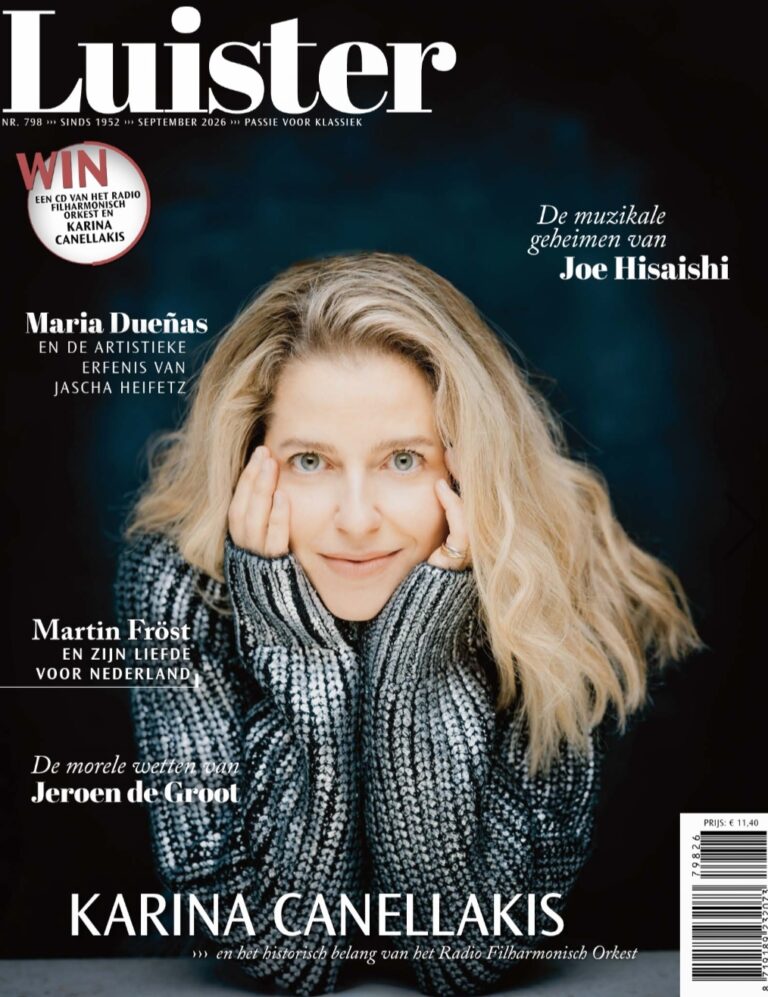
Karina on the Cover of Luister Magazine
KARINA CANELLAKIS ON RACHMANINOFF, EXCELLENCE, THE ORCHESTRA, LIFE AND MORE
“I always hope to retain a childlike sense of wonder”
A BBC Music Magazine Award in the opera category, glowing reviews for her most recent album featuring Rachmaninoff’s The Bells and Symphonic Dances, a contract extension in the Netherlands through 2031, and an extension of her appointment in London through 2030. For Karina Canellakis, the year could hardly be going better. The energetic chief conductor of the Radio Philharmonic Orchestra feels completely at home and is still full of plans.
“The orchestra and the Groot Omroepkoor [Netherlands Radio Choir] are absolutely unique in the world. There is a historical importance to taking good care of them.”
Text: Paul Janssen
Photos: Marco Borggreve
Seven years on
A little over seven years ago, I first met Karina Canellakis. She had just been appointed chief conductor of the Radio Philharmonic Orchestra (RFO), becoming the first woman to lead a Dutch orchestra in that capacity, and the American conductor of Greek-Russian heritage was an international hot topic. Accustomed as she was to the many intrusive and impertinent questions asked by journalists, she had built a wall around herself behind which she kept her innermost thoughts safely hidden. The issue of women as conductors was completely off-limits.
“I’m not thinking about it at all,” was her equally uninterested and evasive response.
By now, the ever-flamboyant conductor has been chief conductor of the RFO for seven years. She enjoys it so much that earlier this year she extended her contract through 2031. She lives in Amsterdam with her husband and children and has become an Amsterdammer among Amsterdammers. On a beautiful spring day, she arrives for our conversation at the Concertgebouw looking remarkably unassuming, and greets the friendly usher on duty like an old friend. After a warm embrace and a promise that she will do her best to attend the farewell party for the usher, who is nearly retired, we settle down in the familiar conductor’s room.
Across from me sits a radiant, self-assured musician who is allowing the energy that was so tightly contained seven years ago to flow freely. She speaks enthusiastically about her work, her life, everything that comes with it—and also about the question of women conductors.
“Seven years ago it was much more of an issue, and at the time I didn’t want to engage with the question.”
At the time, she defended her silence on the subject by explaining: “I grew up in New York in the eighties and nineties, in the heart of Manhattan. Everyone was equal, and my group of friends included every color of the rainbow: men, women, gay, lesbian, transgender and so on. I’m a musician, and I’ve worked hard to get where I am now. I really don’t wonder what I look like when I stand in front of an orchestra.”
By now, she is considerably more nuanced.
“The female conductor seems to have become accepted, normalized, but at many conducting competitions, such as last year’s final of the International Conducting Competition Rotterdam, women are absent. I find that disappointing. Apparently there still aren’t enough of them. Maybe it’s an educational issue.
“I’m now at a stage where I can take on more of a mentoring role, and I’ve started a masterclass at the RFO. I can work with them and help them with their studying. Mentors helped me enormously when I was younger.
“But there is still something in society that prevents women from stepping forward. As if they are too shy. You can’t force it or introduce quotas for the number of men and women. Then you run the risk of very good men being left out. But if you do nothing, nothing happens. Women also need opportunities to gain experience.
“In that respect, my opinion has changed. I’m still not enthusiastic about, for example, a competition exclusively for women, but I’m no longer completely opposed to it. It gives people an opportunity. That’s important. If I see someone who is young, talented, a conductor and a woman, I’m happy to step aside. With a talented man I don’t feel the same urgency, precisely because the balance isn’t there yet. I do what I can to help, but I don’t have the answers.”
Tradition
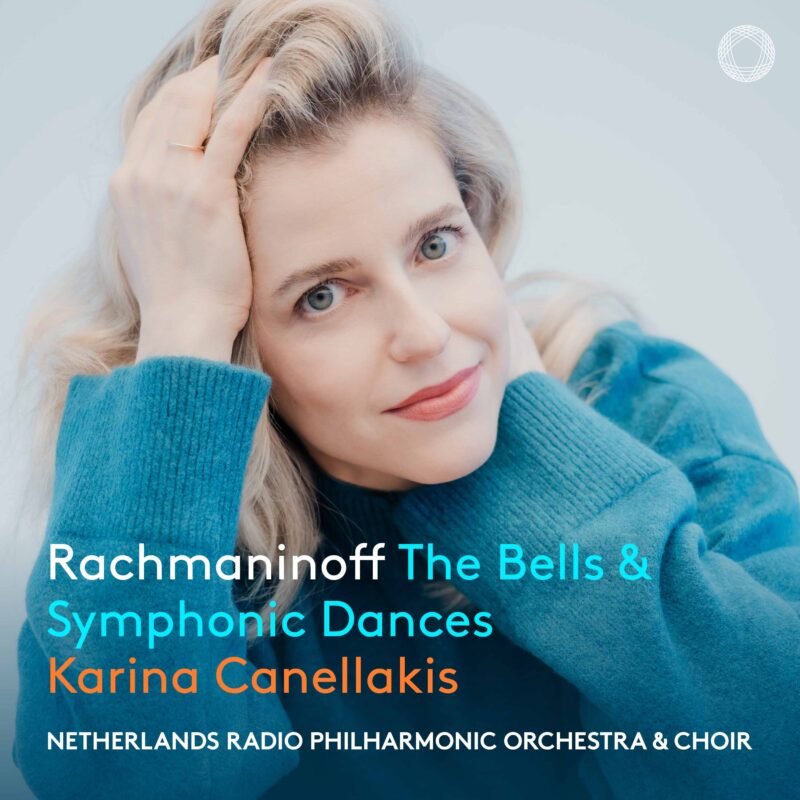
Karina Canellakis herself has long since moved beyond the gender question, simply through the exceptionally high quality she delivers time and again, both live in the concert hall and on recordings. She continues to make recordings successfully and with conviction, as with her latest album of The Bells and Symphonic Dances by Rachmaninoff.
“Many people claim that the CD industry is on its last legs,” she says about making albums. “And on top of that, we have an oversupply of livestreams. We have instant access to live concerts from all over the world. So the question of why you would still listen to a CD is perfectly legitimate.
“For me it’s very simple. First, there is tradition, which I find beautiful. People still collect LPs and CDs. You can hold them in your hands, read the liner notes, put your favorite recordings together on a shelf. It’s the same with reading. Despite e-readers, I love books—their smell, the physical contact with the letters on a page.
“Another point is that I think it’s very important to listen without looking. For years there has also been such an emphasis in the music industry on what people look like, how a conductor moves, how a musician is dressed. None of that has anything to do with the music. You only truly experience the music when you close your eyes. Listening with your eyes closed is deeply satisfying.
“The only difficult aspect of a recording is that it captures time in a capsule. It is a one-time event preserved for eternity. In the next performance there is a different group of musicians—even if you have the same orchestra, you choose slightly different tempos, the interpretation differs. It is always about the performance of that particular moment.
“That’s why I hope to live long enough to do what my mentors did: record the same work again twenty or thirty years later. To me, that is the magic of making recordings.”
Historical importance
The word mentor comes up again. Who are her mentors, and what else has she learned from them?
Her answer is firm:
“I don’t want to focus on that. I can say that Simon Rattle has been a lifelong mentor and good friend; he has had the greatest influence on me. But I prefer not to talk about it anymore. I’ve done that long enough. For a long time I needed support to legitimize what I was doing, but I don’t need that anymore.
“Now that I’m in my mid-forties, I can and want to be judged on my own merits.”
And she is. Very much so.
This spring, together with her RFO, mezzo-soprano Rinat Shaham and bass-baritone Gábor Bretz, she won the 2026 BBC Music Magazine Award in the opera category for their recording of Bartók’s Bluebeard’s Castle. It is recognition for a compelling recording from beginning to end, one that stays with you as a listener.
Canellakis is extremely happy about it.
“It was heard, recognized and acknowledged. I put my heart and soul into it with the orchestra and with my beloved singing friends Gábor and Rinat. How wonderful is it when a general audience—the BBC Music Magazine Awards are voted for by readers—votes for a recording like that.
“I’m also very happy for the orchestra. The RFO deserves much more international recognition. The orchestra is undervalued, even though it is an ensemble that can do everything.
“I think it is important for everyone in the Netherlands that the orchestra has a certain reputation abroad. As with any orchestra that performs internationally, that requires funding. That is crucial to the health and viability of the orchestra.
“The more successful an orchestra like the RFO is with recordings, tours and international festivals, the more the world sees that the Dutch cultural scene is valuable and fantastic. It is worth investing some public money in that. And not only is it worthwhile—it is important. Both because of what the orchestra offers the community and for the orchestra itself.
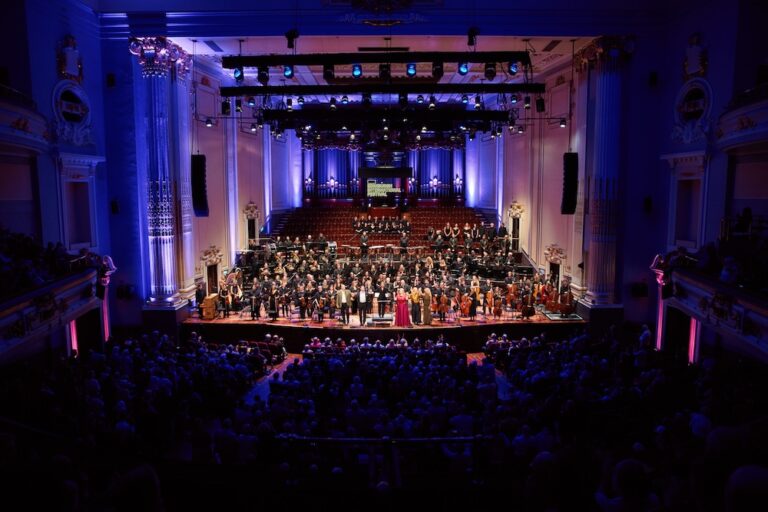
“An orchestra doesn’t become better if it is tied solely to a weekly radio broadcast. Moreover, both the orchestra and the choir are absolutely unique in the world. There is also a historical importance to taking good care of them.”
A delicate balance
Karina Canellakis is clearly devoted to her orchestra, to the musicians, her musicians. In seven years she has developed into a beloved primus inter pares who knows what she has in her hands and what she wants to communicate.
“I’ve learned a lot from the musicians over the past few years. When I started here, I was that young hotshot guest conductor. That was fun, but when you travel from orchestra to orchestra all the time, you never get beneath the surface.
“Here I learned what it means to be a chief conductor, what it means to lead an orchestra. It’s like a marriage. You have to communicate, deal with moments when people aren’t happy or disagree with decisions, and find a way to keep moving forward together every time.
“I can’t run away. I’ve committed myself to so many weeks a year, so I also have to deal with the difficult moments. Those moments often function as a mirror…”
She pauses for a rare moment of silence, then continues.
“You know what’s wonderful about this orchestra? Dutch musicians, and Dutch people in general, say what they think. They don’t fake praise if they don’t like something. They hide nothing. That’s challenging, but ultimately very good for me.
“I learn so much from the musicians, and I’m still learning. I’m a workaholic, I go for details and it’s never good enough. But there are moments when I have to say: that’s enough, let’s go home fifteen minutes early.
“It’s against my nature, but I’ve noticed that many conductors actually produce the opposite effect when they just keep going. It remains a delicate balance. If I say, ‘It’s good enough, let’s go home,’ some musicians are happy and others become restless because they don’t think certain things are good enough yet. I have to listen to that too, but ultimately I’m the boss.
“I have a goal: to establish a standard of excellence. That’s what it’s about. Everything I do or don’t do is part of that process. Ultimately, that level of precision and everyone moving in the same direction should allow masterpieces to truly shine. I always have the final concert in the back of my mind.”
Young blood
Under Canellakis’s dedicated leadership, the orchestra has undergone enormous development.
“I really think the orchestra has improved over the past few years. Not just in terms of playing, but also in terms of the overall culture and how the musicians feel.
“We’re also at an interesting point. For the first time since the last round of budget cuts, many people are retiring and a lot of new blood is coming in—young people.
“We still have a lot of experience in the orchestra, but having young people in crucial positions creates a healthy mix. We have a new principal flutist and a new principal trumpet. Those are things that will change the sound.
“Moreover, young people bring a fresh mentality. They don’t carry the trauma of the cuts. They know nothing about it. I also arrived after the cuts, but especially at the beginning I was confronted with them every day. The fear and trauma among the musicians were significant.
“Young people are like children. They have no idea what happened, and they are playing a lot of repertoire for the first time. They are energetic and full of questions and ideas. That’s wonderful.
“I feel enormously connected to the musicians. That allows me to create the sound I want with these musicians. That is pure luxury for a conductor.”
Golden sound
And there is still much to achieve.
“The orchestra’s name is becoming known internationally. That’s a development that needs to continue, that we need to maintain. At the same time, we continue to work on the beauty of the sound.
“That deep, wonderful golden sound you hear in The Bells and the Symphonic Dances of Rachmaninoff is the sound I want, and want to develop further. We’re on the right path, and I can see and hear where we can grow.
“That’s one of the reasons I extended my contract. We lost a lot of time at the beginning because of the coronavirus pandemic. It started halfway through my first season. The first years were therefore not normal.
“I feel that we lost a lot of time then and that I’m nowhere near finished. As soon as I feel that we no longer have anything to offer each other, I’ll leave.”
That moment is clearly not close. Canellakis wants to continue building a deep relationship with the orchestra.
“Short-term contracts are more or less the norm in the conducting world these days. Conductors stay for a short time, jump around and have lots of orchestras simultaneously. I don’t want that.
“I don’t want to be on an airplane every weekend, even though I tour quite often. I want to work with an orchestra where I know everyone by name and also know something personal about them. I want to know the strengths and weaknesses of every musician in the orchestra.
“It should feel like a family. I love that. I have that feeling with the London Philharmonic Orchestra, where I have been principal guest conductor since 2021. And I have it especially with the RFO.
“That also means everyone has and feels their own responsibility. And you can hear that in the sound.”
Addicted
She refers again to the latest Rachmaninoff album.
“Listen to the details in the orchestration. Everything is there. Because everyone knows what role they play, the significance of the notes they are playing at any given moment, and because everyone is continuously keeping the big picture in mind.
“That made the recording one great celebration.”
There is more that connects Canellakis to Rachmaninoff.
“This album is certainly not a random choice. It’s something I’ve been working toward all my life.
“As a little girl, I first heard Rachmaninoff’s Second Piano Concerto. It was during a rehearsal with a student of my mother’s. I was nine and had just started taking violin lessons. When I entered the concert hall and heard the music, I started crying.
“I still don’t know why, but I immediately knew I wanted to feel that way again. The daughter of my violin teacher gave me a cassette tape—yes, that’s how old I am—with Yefim Bronfman as the soloist.
“Since then I’ve been addicted to Rachmaninoff, and there is a direct line from my heart to his music.”
Fortunately, Rachmaninoff is not the only composer who excites the RFO’s chief conductor. Asked about the most memorable moments of the past seven years, she bursts into a torrent of memories.
“Strangely enough, the first thing that comes to mind is a video project during the pandemic in 2020 with John Adams’s Shaker Loops and Bartók’s Bluebeard’s Castle, with the same cast that is also on the recording of this work.
“It was called The Crazy Project, a recording of an AVROTROS Friday Concert. Indeed, it was a crazy project, with fantastic directors who also had nothing else to do. It was beautifully filmed and brilliantly directed to the music. You can still watch it on YouTube.”
She also has warm memories of performing ARCHE, the oratorio by Jörg Widmann.
“The most difficult work I have ever performed. Nearly three hundred musicians and singers took part. It required two full professional choirs, a huge orchestra, soloists and a children’s choir. It was insane.
“During the rehearsal I needed a microphone to reach everyone. It was also immediately a turning point for the orchestra. Are we capable of doing this? That gave us a lot of confidence.
“It was hard work, but in the end Jörg was enormously happy too. A particularly kind and brilliant man. There isn’t a single mistake in that enormous score.”
Live radio
Naturally, the performances of Leoš Janáček’s operas cannot go unmentioned. With The Cunning Little Vixen, Káťa Kabanová, The Makropulos Affair and From the House of the Dead, she made history and added a chapter to the RFO’s history that was praised around the world.
The operas also had a special significance for her personally.
“During The Cunning Little Vixen, I was eight months pregnant with my first child. It was the last project before I went on leave. Seeing those children coming down the stairs in the opera affected me enormously at the time.”
She mentions plenty of other opera as well—“Berlioz’s La Damnation de Faust was fantastic, and Wagner’s Siegfried… I have a Wagner obsession and really hope to conduct much more Wagner”—but there are many other memorable experiences too.
“I still get goosebumps from the ending of Elgar’s The Dream of Gerontius. That was live radio, you know. A wonderful thing—let me emphasize that as an American. We don’t have that in America.
“It’s truly incredible that an orchestra like the RFO is on live radio every week. I also often listen when I’m not conducting.”
As she talks about highlights, her enthusiasm grows. And when she is asked what she is looking forward to next season, the flow of words becomes unstoppable.
“I’m looking forward to Debussy’s Pelléas et Mélisande. We’ve done very little French repertoire so far, so I’m curious to see how the orchestra develops in this area.
“Mendelssohn’s Elijah also represents a new direction for me and for the orchestra. We haven’t played any Mendelssohn so far, even though I said right from my first season that I wanted more Mendelssohn on the program.
“We’ve focused strongly on early twentieth-century repertoire in recent years, but now, over the coming seasons, it’s time for some lighter works. More Mendelssohn, Beethoven, Schumann, Brahms. It’s a specific sound world and an important source of nourishment for the orchestra.
“Of course we’ll continue to play a lot of twentieth-century and contemporary repertoire, but I think the Classical and Romantic composers are particularly good for the orchestra right now.”
Eating ice cream
Asked about her dreams for the future, she falls silent again for a rare moment.
“I still feel so young,” she eventually says. “That probably comes from the music, my genes and my attitude toward life.”
Her attitude toward life?
“I feel a little like a child every day. Performing ordinary adult tasks, such as answering emails correctly, is a challenge for me. I like doing what I want to do. Fortunately, I became a musician, a conductor. Then I can largely do what I want and keep moving. I love that; I need it.
“In that respect, a conductor has more possibilities than a violinist. That’s another reason I love the profession. If I had only been a violinist, it probably would have caused me a lot of frustration. Practicing indoors, sitting relatively still.
“As a conductor I can study outdoors in my favorite place: nature. I can walk and listen to recordings, or rehearse a piece without a score.
“And what always saves me is working with people. I love working with people. If they inspire me, I can go on all day. And, of course, eating lots of ice cream in between—that’s an important part of living like a child.
“Whatever my next steps may be, I always hope to retain that child’s sense of wonder and create a genuine feeling of family.
“Beyond that, I hope to continue performing repertoire that makes me come alive, such as Wagner’s Ring. Opera is very time-consuming, so for now one opera a year is enough; otherwise I wouldn’t have enough time for the symphonic repertoire. But I love it.
“Just like working with young composers. That’s not only inspiring, but also extremely important for the future of music. I especially want to support young composers I believe in, whom nobody has heard of yet. Then you can build a relationship with them and support them as they write for orchestra.
“But beyond that, I am—and will continue trying to be—present in the moment, in my childlike state. I’m happy where I am now. I only think about today and tomorrow, and I don’t have a particular place I need to get to, even though my concert schedule is already planned through 2029.
“That’s a strange aspect of this profession: I already know where I’ll be in the summer two years from now. Perhaps that also gives me the freedom to live in the moment, because I have some confidence in how my musical career will develop.
“One of the most magical things in life is the unexpected. All the good things in my life, such as meeting my husband, have been unexpected events.
“If I remain completely true to myself and keep working as hard as I like to, unexpected things will come my way. That’s how it has always happened, and I hope I can hold on to that good fortune.
“It is a wonderful and fulfilling feeling to do the things in life that I once dreamed of and worked so hard for. I am grateful for that every day.”